The Jars at the Bottom of the Ocean
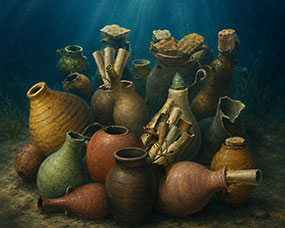
Yesterday I learned that my granddaughter may be looking for a way to remain in France. She is searching for work teaching English, and for the first time I allowed myself to consider that what began as a temporary adventure might become a permanent chapter of her life. It was not really a surprise. Young people grow. They leave. They seek horizons that we ourselves once sought. Yet the news touched something deeper than concern over geography. France is not merely a place on a map. It is another step in the gradual scattering of the family constellation.
As I sat thinking about it, I found myself reflecting on how the family has changed. One grandson has established his own life and career. Another lives across the country. My granddaughter is building her future in Europe. The youngest is approaching the age when the world begins to call louder than home. My sons to one another, and oddly enough, that brings me more comfort than if they called me every day. Perhaps this is one of the strange transformations that come with age. The older we become, the less concerned we are with being the center of attention and the more concerned we are with knowing that the fabric of the family remains intact. We become guardians of the connections themselves.
Last night I remembered a passage from Rudyard Kipling's Kim. An old woman remarks that old people lean upon the young and draw strength from them. At first, I thought about that observation in the most obvious way. The elderly need assistance, companionship, and support. But the more I reflected, the more I saw another side to it. Young people use the old as well—not in a selfish or material sense, but as a source of continuity. A child rarely realizes the extent to which a parent or grandparent serves as a sentinel standing watch behind them. The young move forward into life, confident and fearless, because someone else has been quietly guarding the rear.
When I was young, my grandmother occupied that role in my life. She was part of the landscape of existence itself, as permanent as the walls of the house or the rising of the sun. Like most young people, I did not fully understand what she represented. Only later did I begin to appreciate the immense comfort provided by the simple knowledge that she existed. Her presence formed part of the invisible structure upon which my world rested.
It also occurred to me that there is often a long interval in life when children and grandchildren love their elders deeply but do not yet recognize the value of their experience. They care for them, certainly, but they do not yet understand them. The lessons offered by parents often seem old-fashioned, unnecessary, or irrelevant. Then one day, usually decades later, a strange reversal occurs. A son hears himself repeating his father's advice. A granddaughter suddenly understands a warning her grandmother once gave. Wisdom that once seemed ordinary reveals itself as precious. By then, however, time has already done its work.
These thoughts led me to remember a painting I created nearly thirty years ago. The image came back to me with surprising clarity. At the bottom of a vast ocean rested many jars. Some were sealed. Some were cracked. Some stood open to the water around them. The jars represented individual human beings—their personalities, memories, fears, loves, beliefs, and histories. Each jar appeared separate from the others because of its walls. Yet inside every jar was the same ocean that surrounded it.
At the time I painted it, I did not know much about Advaita Vedanta. I had not yet spent years studying the Bhagavad Gita. Nevertheless, the image carried an intuition that I only later found expressed in philosophical language. The water inside the jar and the water outside the jar were never truly different. The jar merely created the appearance of separation. We identify ourselves with the ceramic walls: our bodies, our thoughts, our opinions, our stories. We say, "This is me," and we forget to ask what it is that fills the vessel.
Last night, for a brief moment, I experienced something difficult to describe. It was not a vision and not an argument. It was more like a fleeting opening in perception. For an instant, the fear of losing my family vanished. Not because I imagined that physical death does not occur. It certainly does. Not because I suddenly believed that personal identities continue unchanged forever. I do not know whether they do. Rather, I felt an overwhelming sense that nothing truly disappears.
The realization brought a peace I had not expected. I have long been terrified of losing those I love. The thought of separation has always carried a sharp edge. Yet in that brief glimpse, the word "loss" itself seemed inadequate. Forms change. Relationships change. Distances appear. Children move away. Grandchildren cross oceans. Bodies age and eventually fail. Yet beneath all those transformations there seemed to be something enduring, something that does not come and go with circumstances.
Of course, the heart immediately raises its objection. Philosophy may speak of permanence, but the heart loves particulars. The heart does not love humanity in general. It loves specific people. It loves a son's voice on the telephone, a granddaughter's laughter, a grandson's visit. It is one thing to say that the ocean remains. It is another to say goodbye to a beloved jar.
Perhaps that is why grief and spiritual insight can coexist. One does not cancel the other. We mourn the forms because the forms matter. We cherish the individual lives because they are beautiful and unique. Yet somewhere beneath the grief remains a quiet intuition that what is most real cannot be destroyed.
I do not pretend to know the mysteries of life and death. I do not know whether we meet again in some future existence. I do not know whether I will one day recognize those I love beyond the boundaries of this life. What I know is much smaller and perhaps much more important. For a brief moment, I looked beyond the walls of the jars and saw only the ocean.
And for that brief moment, I was not afraid.