There is a story I have carried for a long time.
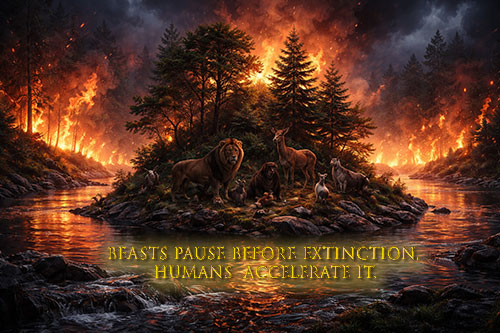
During a forest fire, animals flee toward water. On a small island in the river, predators and prey gather together. The rules that usually govern them fall silent. No one hunts. No one is hunted. The fire has become the predator of predators and prey alike.
Whether every detail of this story is literal matters less than what it reveals. In the presence of a danger that threatens all, hierarchy collapses. Survival no longer rewards domination. The cost of killing exceeds its benefit. Animals pause. Humans do not always do the same.
The Question That Would Not Leave Me
How can human beings—capable of thought, language, and reflection—become crueler than any animal? How do some people not only kill, but enjoy killing, torturing, humiliating? What turns a person into something that seems rabid, possessed, unleashed?
This question is not academic for me. I encountered it early in literature, and later in life, in the street.
As a child, A Tale of Two Cities left a mark that never faded. Dickens does not romanticize the French Revolution. He shows how suffering, once fused with moral certainty, curdles into vengeance. When rage replaces justice, the victim becomes the executioner—and then something worse. Years later, I recognized that atmosphere again.
When the Crowd Enjoys It
I witnessed public rituals of humiliation—people forced to walk through corridors of shouting crowds, stones flying, insults raining down. What terrified me was not only the violence, but the pride afterward. The smiles. The boasting. The pleasure.
This was not chaos. It was permission. The crowd had learned something intoxicating: we decide who belongs, who suffers, who lives with dignity.
That is the moment cruelty becomes moral.
Arjuna’s Refusal
Long before I had words for it, another text articulated the same fracture.
On the battlefield of the Bhagavad Gita, Arjuna lowers his weapons. He sees not enemies, but faces: teachers, cousins, brothers, kin. His refusal is not cowardice. It is moral sight intact.
“How can I kill those who are my own?”
This is the collision most humans avoid. One side must be blinded for violence to proceed. Arjuna refuses to blind himself.
The teaching that follows is often misunderstood. It is not a permission slip for cruelty. It is a warning against acting from ego—against identifying with power, hatred, or righteousness.
The Mechanism: Fear, Permission, Power
Cruelty does not require monsters. It requires conditions.
Fear generates anger.
Anger seeks discharge.
Permission removes restraint.
Power delivers intoxication.
The pleasure is not in killing itself. The pleasure is in hierarchy.
“I am above you. I decide. I have the power to kill you or let you live”
This is why rape is about domination, not sex. Why torture escalates. Why mobs grow louder and happier. The suffering of the other becomes proof of superiority.
Animals do not do this. They do not ritualize cruelty. They do not savor humiliation. They kill to eat or survive—and stop.
Humans, armed with ego and symbolism, can turn violence into meaning.
Ego as the Root
Everything returns to the ego.
The ego’s first lie is separation: I am more real than you. From that distortion flow entitlement, superiority, dehumanization, and cruelty without remorse.
Unchecked power feeds the ego like oxygen. Fear hardens it. Ideology dresses it in virtue. When ego inflates, empathy collapses.
That is why catastrophe can lead either to solidarity—or to savagery. Animals only have the first option. Humans invent the second.
What Still Matters
Not everyone crosses the line. In every crowd, some refuse. Some keep the face visible. Some do not trade conscience for belonging.
Arjuna trembles—and that trembling is the proof that the beast has not won.
The story of the fire and the island stays with me because it exposes an uncomfortable truth: nature does not need cruelty to function. Humans often do, because cruelty feeds ego. Remembering this is not despair. It is vigilance.
This is a Truth Log entry—not a verdict, not a manifesto. Just a record of what I have seen, read, and learned the hard way.
When the fire becomes the predator, hierarchy collapses.
The question is whether we will let ego collapse with it.
— End —