
There are two very different ways people stand before sickness, aging, and death. They do not argue with each other. They simply inhabit different worlds.
The First Way: The Hope of Restoration
In this way, illness is an error, a glitch, a temporary malfunction.
Doctors are not collaborators in understanding; they are restorers expected to return the body to its previous state: to youth, to wholeness, to control.
This mindset does not necessarily arise from ignorance. It arises from refusal to accept irreversibility. If the right specialist is found, if the correct surgery is performed, if the right test is done, decline can be reversed.
This way lives on promise. It must. Because to admit that some things do not return is to face time itself; and time does not negotiate.
The Second Way: Acceptance Within Structure
In this way, illness is not always a mistake. It is sometimes part of the Mythos. Medicine is respected; deeply respected; but not deified.
Doctors can relieve, manage, support, and sometimes cure. But they do not grant immortality. They do not rewind years or bargain with entropy. This way does not reject treatment.
It simply refuses to mistake treatment for salvation.
There is quiet strength in this posture.
It says: “I will care for my body. I will seek help when needed. But I will not demand from medicine what medicine cannot give.”
This way lives on clarity.
The Question
Which way is stronger?
The way that insists on restoration at all costs can appear hopeful. But that is a superficial reading. The first way is often powered by fear: fear of losing youth, mobility, relevance, autonomy.
The second way can appear resigned, even pessimistic. It is not the absence of fear. It is the refusal to organize life around denial.
Those who live in the second way do not wish for death. They simply do not treat it as an enemy that can always be defeated.
Perhaps both are attempts at courage; but only one rests on reality.
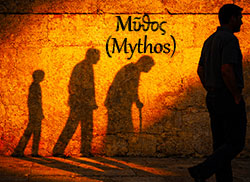
Mythos (μῦθος): The Structure of a Life
I am using the word Mythos as Aristotle used it. Mythos does not mean fantasy. It means the ordered whole of a story.
A life, seen clearly, has Mythos. That word carries: Structure. Rise. Turn. And Completion.
In classical dramatic form, it unfolds like this:
- 1. Protasis (πρότασις) – The Beginning. The initial situation. Childhood.
- 2. Epitasis (ἐπίτασις) – Intensification. Tension rises. Adulthood.
- 3. Climax (κλῖμαξ) – The turning point. Often includes Peripeteia (περιπέτεια), reversal. Midlife.
- 4. Anagnorisis (ἀναγνώρισις) – Recognition. The moment truth becomes visible. Maturity.
- 5. Catastrophe (καταστροφή) – Literally “the turning down.” Not disaster, but structural descent. The movement toward closure. Old age
- 6. Catharsis (κάθαρσις) – Purification. Release. The resolution that follows completion. Catharsis is not the descent itself, it is what becomes possible once the Mythos has been fulfilled.
Conclusion
To stand before illness is to stand somewhere within one’s own Mythos .
The First Way fights the structure of the story. It demands that the turning never occurs, that descent be postponed indefinitely. It asks medicine to interrupt the Mythos .
The Second Way understands the Mythos is not an insult. It is form: Youth rises. Strength intensifies. Recognition comes. Descent follows. Release completes.
Accepting this is not weakness. It is alignment. The Second Way is Aristotelian because it accepts that life is not a machine to be repaired into permanence, but a narrative with structure.
Medicine belongs within the story but it is not the author. The body does not fail because it is defective; it moves because it is alive.And every living structure has its protasis, its intensification, its turning, its descent.
The question is not whether we will reach the catastrophe. The question is whether we will meet it in denial — or in recognition.
Only one of those positions allows for catharsis.