
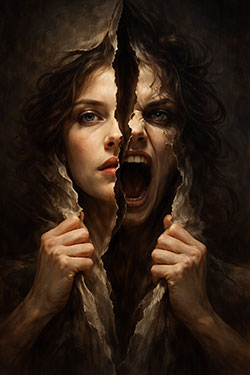
Modern medicine defines schizophrenia as a severe disorder of thought and perception. It is described in terms of hallucinations, delusions, and a fragmented sense of reality. Treatment focuses on stabilizing the mind and restoring ordinary functioning.
Yet this modern definition is only one way of understanding the phenomenon. Across history and across cultures, experiences that resemble what we now call schizophrenia were often interpreted very differently.
The condition itself may not have changed — but its meaning has.
In many traditional societies, individuals who heard voices or saw visions were not automatically considered ill. Instead, they were sometimes regarded as people standing at the threshold between worlds. Shamans, healers, and seers often described experiences that today would be classified as psychotic. Dreams, visions, and voices were treated as meaningful events requiring guidance rather than suppression.
These cultures did not necessarily romanticize suffering. They recognized that such states could be dangerous and destabilizing. But instead of isolating the individual, they attempted to integrate the experience into the structure of the community. The visionary was not abandoned; he or she was mentored.
In parts of India, intense inner experiences could be interpreted as a form of spiritual awakening — a rising of energies that required discipline and guidance to remain balanced. Such states were not considered harmless, but neither were they automatically dismissed as pathology.
Ancient Greece preserved a similar ambiguity. Philosophers spoke of what they called divine madness — a state through which prophecy, poetry, and inspiration might emerge. The boundary between wisdom and madness was not always clearly drawn.
Other civilizations adopted darker interpretations. In parts of medieval Europe, unusual perceptions were frequently interpreted as signs of possession or demonic influence. Individuals who might once have been regarded as visionaries were instead feared and sometimes persecuted. What one society called inspiration, another called corruption.
The same human experiences moved from one meaning to another depending on the cultural lens through which they were viewed.
Today, the medical model dominates our understanding. This model has brought undeniable benefits. Many people suffering from severe psychotic states have found relief through treatment and support that earlier societies could not provide.
But the medical model also narrows the interpretation of these experiences. Voices and visions are treated primarily as symptoms rather than as experiences that might carry personal or symbolic meaning. The inner world of the patient is often reduced to pathology.
As a result, people who live with schizophrenia are frequently seen only through the language of diagnosis. They are classified, managed, and often isolated. Their experiences are explained rather than understood.
The modern world tends to fear what it cannot easily interpret. Experiences that fall outside ordinary perception are quickly labeled as dysfunction.
Yet history suggests that human beings have always encountered states of mind that lie beyond ordinary boundaries. Different civilizations responded in different ways — sometimes with reverence, sometimes with fear, and sometimes with attempts at healing.
Perhaps the deepest question is not whether schizophrenia is an illness. In many cases it clearly is, and its suffering is real.
The deeper question may be how societies choose to interpret unusual forms of perception — and what is lost when only one interpretation is allowed.
What earlier cultures sometimes treated as a dangerous opening toward hidden dimensions, we now describe entirely in clinical terms.
We may have gained knowledge.
But it is possible that we have also lost a way of listening.