THE HERMIT WOLF
TRUTH LOGS
THE HERMIT WOLF
TRUTH LOGS
THE HERMIT WOLF
TRUTH LOGS
THE HERMIT WOLF
TRUTH LOGS
April 5, 2026
Etymology: From Terrace (English root, understood locally). Spanish suffix -eño (denoting belonging or habitual association, as in habanero, porteño): Terraceño: "one characterized by the terrace".
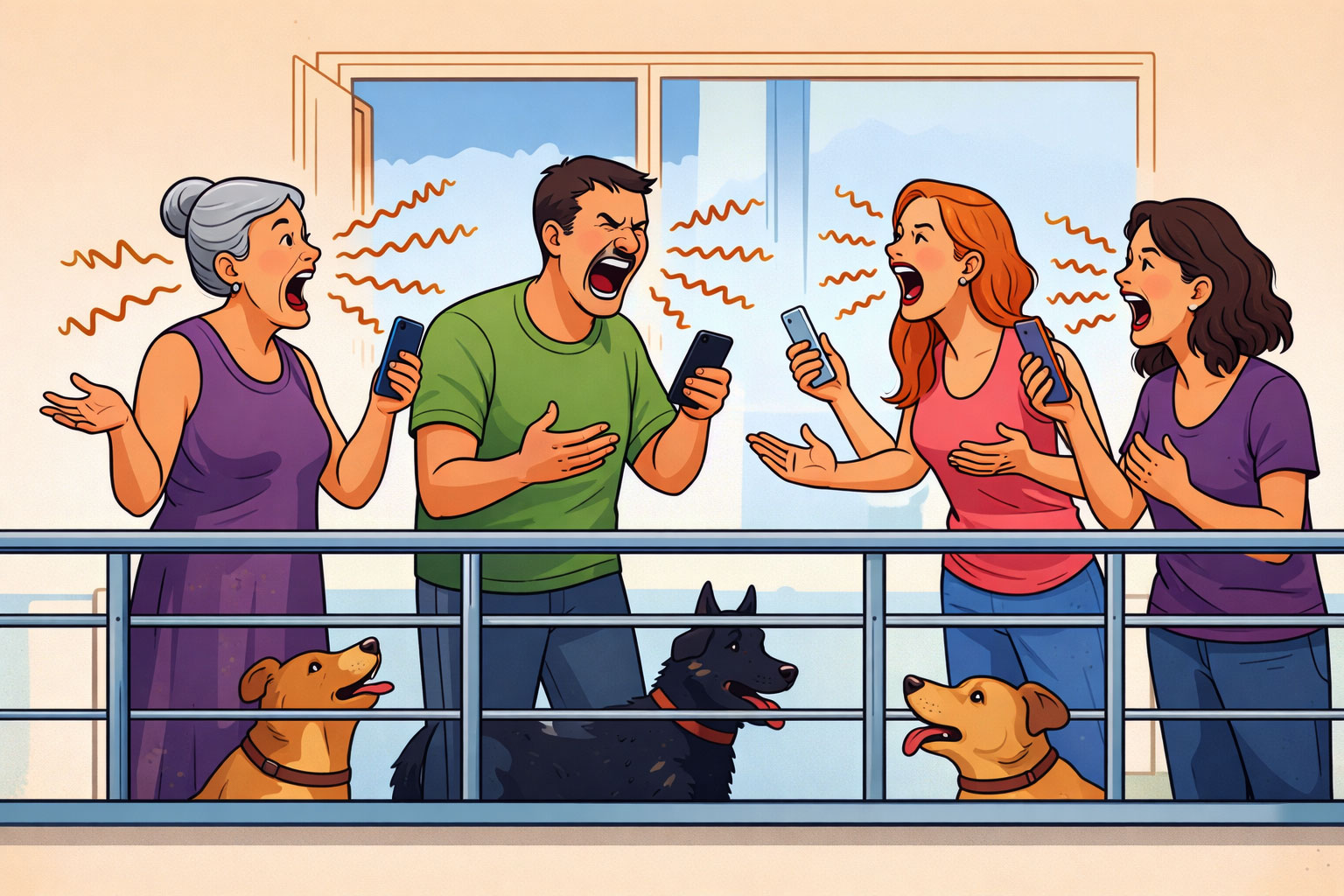
In every building there emerges, sooner or later, a new species—not listed in any formal taxonomy, yet unmistakable once observed. Ours has now stabilized into a recognizable form: Homo terraceños vocalis.
This specimen does not inhabit the apartment proper. The interior, with its walls and contained acoustics, appears insufficient. Instead, it migrates outward—to the terrace—where life unfolds in full extension: breakfast, phone calls, commentary, announcements, and what can only be described as acoustic declarations of existence.
The defining trait is not presence, but projection. Distance does not diminish volume. A conversation conducted at arm’s length is delivered as if across an ocean. One might conclude that the intended recipient is not the person nearby, but a distant homeland, perhaps even an entire archipelago.
The terrace, therefore, ceases to be architectural. It becomes theatrical.
From a physiological standpoint, there is no apparent strain. The vocal apparatus of H. terraceños vocalis sustains prolonged output with remarkable endurance, suggesting either adaptation or indifference to feedback mechanisms that regulate most human speech.
Observation notes indicate peak activity in the early morning—just as the more interior-bound species attempts to engage in reflection, reading, or silence. The overlap of these incompatible behaviors produces a curious ecological tension: one organism seeks quiet; the other broadcasts life.
No malice is detected. Only amplitude.
And so, the classification stands—not as complaint, but as record. A naming of what is plainly there. Because once a behavior acquires a name, it becomes visible. And once visible, it becomes—if not avoidable—at least understandable.