THE HERMIT WOLF
TRUTH LOGS
THE HERMIT WOLF
TRUTH LOGS
THE HERMIT WOLF
TRUTH LOGS
THE HERMIT WOLF
TRUTH LOGS
There are questions that begin in universities, born from years of formal research, statistical analyses, and scholarly debate. Others emerge much more quietly. They arise while hanging a painting on a wall, watching a child say goodbye to friends for the fifth time, or hearing that a hurricane has carried away not only a roof but an entire wall. Such moments seem unrelated, yet over time they begin to point toward the same question.
What gives human beings the feeling that they are truly safe?
I have come to believe that the answer has much less to do with physical security than with what might be called the psychology of permanence. We all need to feel that somewhere in our lives there exists something that will remain unchanged while everything else continues to move. We seldom recognize this need because, under ordinary circumstances, it quietly accompanies us throughout our lives. Only when permanence is broken do we realize how much we depended upon it.
When I first arrived in the United States from Cuba, I was surprised by the level of anxiety that surrounded the approach of a hurricane. Having lived through many storms in Havana, I had learned a very different lesson. We stored water, bought candles, prepared kerosene lamps, and accepted that the electricity might disappear for several days. Occasionally we had to clear drains clogged by leaves after torrential rains, but the house itself was never in doubt. The building stood. It protected us. Once the storm had passed, life gradually returned to normal.
Then Hurricane Andrew struck South Florida.
When I telephoned relatives who had survived the storm in Homestead, they assured me that they were alive but casually mentioned that the wall separating their apartment from the neighboring one had disappeared. I remember sitting in silence after hearing those words. I could scarcely understand what they meant. How could a wall disappear? To someone whose entire life had been spent in concrete and masonry buildings, the statement sounded almost impossible. It was not simply a matter of different construction techniques. It was the collapse of an assumption I had never realized I carried with me: that a home was the one place that remained standing while the storm passed.
Years later, I found myself hanging a painting in my own home. The nail entered the wall so effortlessly that it felt as though I were hammering into a wooden crate rather than into the walls of a house. Instantly, memories returned of the homes in Cuba and later in Prague, where hanging even a small picture required powerful drills capable of penetrating concrete and brick. Those walls resisted. They conveyed mass, solidity, and permanence. Without ever intending to do so, they communicated a silent message to those who lived within them: this place will protect you.
I began to wonder whether architecture does more than shelter us from rain and wind. Perhaps it also educates the subconscious. Every wall we touch, every floor we walk upon, every building that quietly survives another generation may be teaching us what to expect from the world.
The same question arises after an earthquake. When an entire neighborhood collapses, engineers rebuild roads, bridges, and houses. Yet something far less visible proves much more difficult to restore. The earth itself no longer feels trustworthy. Survivors often describe a lingering sensation that the ground beneath their feet has betrayed them. Rationally they understand that the earthquake is over. Emotionally, however, the contract between themselves and the land has been broken. The disaster may have lasted less than a minute, but its psychological aftershocks continue long afterward.
A pattern observed among children of military families and diplomats is that they often spend their childhoods moving from one city or country to another. Many become remarkably adaptable, capable of entering new cultures with ease. Moving repeatedly every few years they find themselves in another school, another neighborhood, another city and discover that attachment was repeatedly followed by separation. Their young minds sought the simplest possible solution: avoid becoming attached in the first place. It is not that they lacked the capacity for friendship, they lacked confidence that friendships could endure.
Why should I make friends if my family is going to move again and I'll lose them?
As they grow up and become independent, they can create lasting relationships, however they frequently describe an underlying difficulty in putting down emotional roots. Home ceases to be a particular house or town. Instead, home becomes the family itself. Permanence migrates from geography to relationships.
Sometimes permanence migrates into objects.
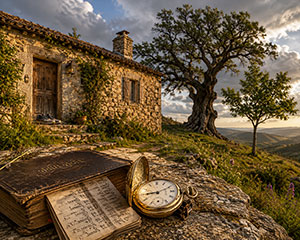
In earlier generations, the family Bible served a similar purpose. It contained not only sacred scripture but also the births, marriages, and deaths of successive generations. Within the same covers were preserved both the history of faith and the history of a particular family. Such objects became silent witnesses, reminding each generation that they belonged to a story much older than themselves.
As the years pass, life gradually teaches us another lesson. Trees that have shaded our homes for decades may disappear through decisions beyond our control. Carefully cultivated gardens can be altered forever. A brand-new car, parked exactly where it should have been safest, may suddenly acquire an accident record through no action of its owner. One slowly discovers that much of what we call control is far more limited than we once imagined.
Perhaps this realization explains why so many people eventually feel as though they are floating on a small raft in the middle of a restless ocean. The landmarks that once inspired confidence begin to disappear one by one. Home changes. Health changes. Society changes. Even our own bodies refuse to remain as they once were. The comforting belief that we can preserve life exactly as we wish gradually dissolves.
Psychology often interprets this discovery as anxiety. If everything can be taken away, then nowhere feels completely safe. The subconscious remains alert, waiting for the next unexpected loss.
Philosophy approaches the same observation differently. Rather than asking how to make an impermanent world permanent, it asks whether permanence was ever meant to be found in external things at all. The great contemplative traditions of humanity, from the Buddha to the biblical wisdom literature, repeatedly arrive at the conclusion that suffering arises not because the world changes, but because we expect it not to.
Most people, however, do not begin with philosophy. They begin with loss. Only afterward do some gradually discover wisdom.
Perhaps that is why the search for permanence has accompanied humanity since the beginning of civilization. We have sought it in stone buildings, in family heirlooms, in nations, in marriages, in traditions, in memory, and in faith. None of these escapes time entirely, yet each represents an attempt to answer the same fundamental human need.
The psychology of permanence, then, is not really about architecture, hurricanes, earthquakes, or even family history. It is about the deep human longing to know that somewhere, amid a world that changes without asking our permission, there remains something that can still be trusted.
Perhaps every civilization answers that question differently. Perhaps every family does as well. Yet beneath those different answers lies the same universal hope: that while we ourselves are temporary, not everything we love must disappear with us.