THE HERMIT WOLF
TRUTH LOGS
THE HERMIT WOLF
TRUTH LOGS
THE HERMIT WOLF
TRUTH LOGS
THE HERMIT WOLF
TRUTH LOGS
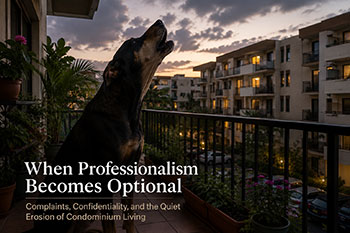
I am very scared by what I have been observing lately. In two words, everything seems to be going to the dumps. I am not much out in the world anymore; in fact, my AKA is Hermit Wolf. I retired from work and, to a large extent, from the world in 2010, and I have not spent much time outside it since. The fact that even with so little contact I can still see services, professionalism, dedication, empathy, compassion, and a great many other human qualities deteriorating is, by itself, frightening.
I live in a Miami condominium. When I bought my property here, it was an appealing place, full of greenery: bottlebrush trees, bougainvilleas, hibiscus, large mandevillas, palms, and other plantings that made the grounds feel alive. Management was strict, the rules were enforced, and neighbors' complaints were handled as they should be: privately and with reasonable expediency. Not everything was ideal. Assigned parking for owners and renters did not exist, and it still does not; parking remains first come, first served, even though many condominiums in the area assign one space per unit and leave the remainder for visitors. There were other restrictions too, some of which I can no longer remember, but the one that bothered me most was the prohibition on pets. Children were not accepted either.
The prohibition on pets bothered me deeply because I have been an animal lover all my life. At the time I had a cat, and that is a subject I still cannot talk about easily. Later I had a dog, and I used to take him outside before sunrise so he could do what dogs need to do before the neighbors could see me and report me, which they did regularly. The rules could be harsh, but they were rules, and at least one knew where one stood.
Then things began to change. Trees were ordered cut down; mandevillas, bougainvilleas, palms, hibiscus, and other vegetation disappeared. Neighbors with a single apartment were allowed to park three cars even when only two people lived in the unit. Gradually, the pendulum swung from excessive restriction toward something closer to no restriction at all. I still have not seen anyone keeping a tiger or a monkey, but dogs of virtually every size and breed are now accepted. The 948-square-foot apartment above mine has at times accommodated four people, one large poodle, and two Shih Tzus.
Complaints to the condominium office about persistent disturbances have often produced little or no visible response. There has been prolonged barking and howling, furniture being dragged at two in the morning, and a succession of other noises that go far beyond the ordinary sounds of communal living. I have even written humorous stories about some of these episodes and devoted part of my website to describing the pets and inhabitants involved. Humor helps, but it does not solve the underlying problem.
Now we have arrived at something different, and more troubling. I am not going to write here about information obtained through the grapevine: stories about presidents allegedly abusing their position to fire people who acted against their private wishes, long-standing employees being dismissed without explanation, or decisions such as cutting down my privacy screen because, apparently, palm trees breed rats. Those matters would require evidence I do not possess. I am concerned instead with something I can describe directly: the apparent practice of passing a resident's complaint to the person being complained about while identifying the complainant by name and unit.
A competent management system should receive a complaint, document it, determine whether it concerns a violation of condominium rules, investigate or corroborate it when appropriate, and then deal with the unit involved. A notice such as, "Management has received complaints regarding persistent noise from your apartment," is ordinarily enough to begin that process. Unless identification becomes necessary in some later formal proceeding, there is very little administrative purpose in turning the matter into a personal exchange between Neighbor A and Neighbor B.
Park East is a condominium community of roughly four hundred apartments. In a community of that size, complaints are inevitable: noise, parking, pets, maintenance, water, construction, alleged rule violations, and disputes about whether a rule has been violated at all. That is precisely why there is a management office. Its function is not merely to act as a messenger service between residents; it is supposed to provide an institutional mechanism for handling conflicts that hundreds of households cannot reasonably negotiate one by one.
The consequences of identifying complainants are not difficult to foresee. It converts a management problem into a neighbor-versus-neighbor problem, invites confrontation, creates resentment, and exposes the person who complained to retaliation or harassment. Most importantly, it teaches residents a very practical lesson: do not complain. Once residents learn that reporting a problem may create a second problem for them personally, they stop reporting, and management loses precisely the information it needs in order to enforce its own rules.
That is the institutional absurdity. Management may have residents who can independently corroborate a nuisance complaint, yet its own previous handling of complaints may make those residents unwilling to participate. That is not merely poor customer service; it damages the condominium's own enforcement mechanism. A large residential community depends on residents to report conditions that management cannot possibly observe continuously. No management office can stand inside every hallway, beside every wall, under every balcony, or outside every door at every hour of the day and night.
Residents are therefore part of the information system whether management likes it or not. If they come to believe that reporting a problem may expose them to interpersonal conflict, they remain silent. Management then knows less, problems persist longer, resentment accumulates, and eventually the office may conclude that there is no serious problem because "only one person has complained." Perhaps only one person complained because everyone else learned not to.
I am not asking for monastic silence. I live in a condominium, and I understand perfectly well what that means. People walk, furniture moves, children exist, dogs bark, contractors drill, vacuum cleaners operate, and life makes noise. Prolonged, repetitive disturbance is something else. A condominium has rules precisely because several hundred households cannot simply negotiate every conflict among themselves, and administration exists to provide a fair and consistent structure for resolving those conflicts.
That requires more than answering a telephone or forwarding a complaint. It requires judgment, procedure, consistency, and enough professionalism to understand that when a resident reports a problem, management should address the problem itself rather than create a new conflict by identifying the person who complained.