
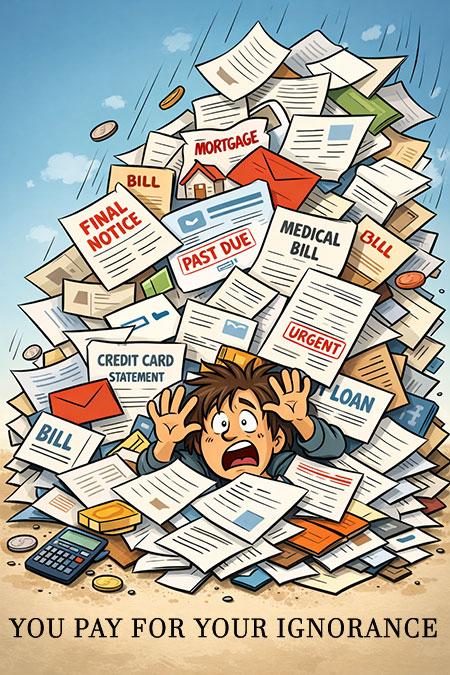
I came to the United States from a place where economics was not something you studied. It was not discussed in school, not taught in university, not part of daily language. Not because it didn’t exist, but because it was centrally managed. You lived inside it without needing to understand it.
In Cuba, when I was raising my children, I did not pay for doctor visits. I did not pay for hospital stays. I did not pay for medications. I did not pay for childcare. These things were not “benefits”; they were simply part of life. What you paid for were your house, electricity, water, food. The rest was opaque, handled elsewhere.
So economics was invisible — not as an abstraction, but as a daily skill. No one taught us how systems were funded, how costs were distributed, or how risk was priced. There was no need to know.
Then I arrived in the United States — a country where economics is not invisible at all. It is everywhere. It is assumed knowledge. It is the grammar beneath every decision: insurance, healthcare, housing, food, retirement. And no one explains the rules.
I didn’t know how to write a check. I didn’t understand premiums or deductibles. I didn’t understand why something could be “covered” and still cost money. I didn’t understand that understanding economics is not optional here — it is survival literacy.
This difference matters, because systems that assume knowledge punish those who arrive without it. Quietly.
The hidden curriculum
In the U.S., there is a hidden curriculum that is never taught explicitly:
- You are expected to know how insurance works.
- You are expected to understand cost-sharing.
- You are expected to optimize purchases.
- You are expected to compare plans, prices, unit costs.
- You are expected to know when something is “cheap” and when it is expensive in disguise.
If you don’t know these things, you don’t fail publicly. You simply pay more. Over time. In small, exhausting increments.
This is not about intelligence. It is about prior exposure.
People who grew up in capitalist systems absorb this language early. People who come from centrally managed systems do not. That gap doesn’t close automatically. It costs money to learn it — and sometimes pain.
Inflation is not the same for everyone
Years ago, I learned something important from someone who had lived his entire life inside wealth. He taught me that buying wholesale — BJ’s, Costco — is not just cheaper. It is safer. Prices fluctuate less. Unit costs are lower. You are insulated.
That lesson stayed with me because it explains something fundamental: inflation is class-segmented.
Take a simple example. Yogurt.
Five or six years ago, the almond milk yogurt I bought cost about one dollar. Today it costs a little over two dollars. That is more than double.
For someone with money:
- That increase is an annoyance.
- They buy in bulk.
- They absorb the cost.
- They don’t think about it again.
For someone buying piecemeal:
- That increase changes what they eat.
- Or whether they eat it at all.
- Or whether they replace it with something worse.
Same product. Same price increase. Completely different impact.
This is why official inflation numbers often feel disconnected from lived reality. They measure averages. They assume substitution. They assume flexibility. They assume buffer.
But many people do not live in the average. They live in necessity. And necessity does not substitute easily.
Medicare as a case study in delayed truth
Healthcare is where this becomes most visible.
You can work for decades, pay into a system your entire life, and only later discover how it actually functions — when you are already dependent on it.
The issue is not that Medicare costs money. The issue is when and how that fact is explained.
If, from the beginning of working life, people were told clearly: “The money taken for Medicare does not mean your healthcare will be fully paid later. You will still pay premiums. You will still have deductibles. You will likely need additional coverage.”
That would be informed participation.
Instead, the explanation arrives late. At retirement. At illness. At dependency. When reversal is impossible.
This is not malice. It is structural opacity. And opacity always benefits systems more than people.
Immigration is also economic translation
This is why immigrants from centrally managed economies begin at a disadvantage that is rarely acknowledged.
It is not only language or paperwork. It is economic fluency.
When you arrive from a system where healthcare is not priced at point of use, childcare is not monetized individually, and risk is pooled invisibly, you are stepping into a system where every interaction has a price tag — and where misunderstanding that price has consequences.
No one tells you that explicitly. You learn by paying.
Not everything must be fought
This is not a call to action. It is not a proposal. It is not a demand.
Some systems are like mud. You do not push them. You do not fight them. You learn where to step, and where not to.
Understanding does not obligate struggle. Sometimes understanding is enough.
I am not writing this to fix anything. I am writing it to name something that is rarely named: the cost of delayed explanation, and how it falls hardest on those who arrive without economic language.
Seeing that clearly changes nothing outward — but it changes how you carry it.
And sometimes, that is sufficient.
Tip: Replace the image filename in the <img> tag with your final cartoon file name (e.g., medicare-mud-cartoon.png).