THE HERMIT WOLF
TRUTH LOGS
THE HERMIT WOLF
TRUTH LOGS
THE HERMIT WOLF
TRUTH LOGS
THE HERMIT WOLF
TRUTH LOGS
My father used to say: “Nobody is completely normal.”
When I was young, I thought he was joking. Now, after seventy-seven years of observing people, I am no longer so sure.
For most of my life, I have been fascinated by a question that has never left me: Why do some people seem to live in only one room of life's mansion, while others wander endlessly from room to room, discovering new wonders behind every door?
I first noticed it among my classmates.
There was one young man who lived entirely in the world of physics. He was brilliant. Numbers, equations, theories; those he understood. But ask him about literature, language, history, art, or nature, and it was as if those rooms did not exist. I was once asked to help him with French and English, and I still remember my despair at the atrocities he committed against both languages.
Later I noticed the same phenomenon in adults. My first husband was an exceptionally good man. Honest. Decent. Kind. Yet he was so absorbed by scientific investigation that the rest of life often disappeared from view. When our first child was born, science occupied his attention. When another child was ill, science occupied his attention. He was not choosing science over his family in any conscious or cruel way. He simply seemed unable to stop following the thread of inquiry that dominated his life.
For years I wondered about this. Why do some people become so identified with one aspect of existence that everything else fades into the background?
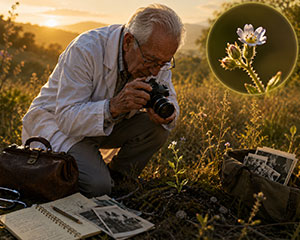
Then there was my father who was a physician. He was also a teacher. He wrote scientific papers. He wrote travel articles. He loved photography. He loved conversation. He loved learning and best of all he loved us, his wife and daughter, and dedicated much of his free time to us. And after retirement, when many people narrow their lives, something unexpected happened: his world expanded.
He began photographing flowers, not roses. not orchids; tiny flowers that most people never notice so small that they could fit upon the nail of a little finger. He would photograph them in extreme detail and then show the images during lectures.
"What flower is this?" he would ask.
People would guess roses, orchids, lilies.
Then he would reveal the actual size of the flower, and the audience would gasp.
One day he said something that has remained with me ever since:
"I never imagined how beautiful life is." The statement astonished me.
Here was a man who had spent decades healing people, teaching students, traveling through Cuba and beyond, writing, reading, and observing the world, yet even he felt he had barely begun to see.
Perhaps that is why I have always struggled to understand people who notice only one thing; not because they are wrong or even less because I could consider them inferior. But because existence appears so impossibly rich it seems to be a sin not to admire it.
There are many mansions in the world of the Lord. I would say, creation is so vast, so beautiful. It has the best and what many would call the worst: a volcano erupting, the earth shaking, the sea lifting in a tsunami of incredible proportions. On the other hand, beautiful landscapes, valleys, the sky at night when the light pollution lets you watch it. The incredible variety of flowers and flowers and birds.
When a butterfly lands on a flower or a dove repeatedly tries to perch on a curved trellis, slides down, flutters indignantly, and tries again. Or when you observe the way an orchid blooms, how geological formations reveal a story millions of years old. And when a verse of scripture suddenly acquires a meaning it did not possess yesterday.
How can one not stop and look?
A few days ago, a giant swallowtail butterfly visited my terrace. It seemed determined to tease me because whenever I reached for a camera, it vanished. Whenever I gave up, it reappeared, so in the end, I never obtained the photograph.
But I observed the butterfly, and perhaps observation is more important than possession.
The butterfly reminded me of something I had suspected for a long time.
The difference between people is not merely intelligence, education, wealth, or profession. The difference may be attention. Some people spend their lives looking through a narrow window while others keep opening windows.
Some remain within a single room, and others wander through the mansion’s multiple rooms.
Neither path is necessarily better; civilization needs scientists, teachers, builders, accountants, artists, mechanics, parents, and dreamers.
But I confess that I admire those who never lose their capacity for wonder. Those who, even in old age, can still be surprised by a flower smaller than a fingernail.
Those who can still look at a butterfly and think: "What a marvelous thing this world is."