THE HERMIT WOLF
TRUTH LOGS
THE HERMIT WOLF
TRUTH LOGS
THE HERMIT WOLF
TRUTH LOGS
THE HERMIT WOLF
TRUTH LOGS
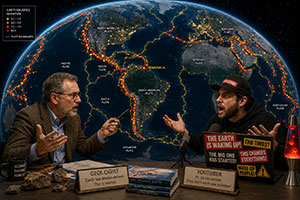
When a strong earthquake strikes somewhere in the world within minutes, before seismologists have finished locating the epicenter or estimating the final magnitude, the machinery begins to move. Notifications appear. Videos multiply. Faces wearing expressions of grave certainty look into cameras and announce that this is not merely another earthquake. No, this one is different. This one is a warning. The Earth, they tell us, is entering a new phase.
I was brough awake today with the phrase: “Yesterday the whole world shook.” I had been checking all the seismic regions of this same world, the Ring of Fire, the Atlantic Region, Asia, Mediterranean, Southeast Asia, Indonesia… the seemingly unending list of earthquakes taking place in our world. I hadn’t seen any signal that ‘the whole world’ had shaken.
It is an old performance, repeated so often that one wonders whether the earthquake itself or the predictions that follow have become the more predictable event.
The recent earthquakes in Venezuela are a tragedy. Lives have been disrupted, families have suffered terrible losses, and communities now face the long task of rebuilding. Such events deserve our sympathy, our attention and, whenever possible, our help. They do not deserve to be transformed into props for apocalyptic entertainment nor for making money.
What fascinates me is not the earthquake itself but our reaction to it. It is as though every generation must rediscover, with genuine astonishment, that the Earth is a restless planet.
We have come to imagine that an earthquake is an exception to the normal order of things. It is not. It is the normal order of things.
The continents on which we build our cities are not fixed platforms resting upon an immovable foundation. They are immense fragments of crust, floating upon a planet whose interior has never ceased to move. They advance at the leisurely pace of fingernails growing, yet over years, decades and centuries they accumulate enormous tensions. When those tensions are finally released, the Earth does exactly what physics has always required of it.
It shakes; it has been shaking for millions of years, and it will continue to shake long after every human monument has disappeared.
This does not diminish the suffering caused by a destructive earthquake. On the contrary, understanding the process reminds us that nature is indifferent to our calendars, our borders and our expectations. The Earth is not angry. It is not sending messages. It is not announcing the end of civilization. It is simply obeying the laws that have governed it since long before our species appeared.
Yet there is very little profit in saying, "The Earth behaved today exactly as geologists expected." There is far greater profit in saying, "This changes everything."
Fear has become a remarkably successful business model. The more frightening the headline, the more likely it is to be shared. The more dramatic the thumbnail, the more likely someone is to click. Calm explanation competes poorly against imminent catastrophe.
The irony is almost painful. We live in an age in which humanity has accumulated more scientific knowledge about our planet than at any other time in history. We can detect earthquakes within seconds, map tectonic plates with extraordinary precision, measure the slow drift of continents from satellites orbiting hundreds of kilometers above us—and yet millions of people still finish the day believing that a magnitude-six earthquake somewhere in the world is evidence that something unprecedented has begun.
It has not. What has begun is another cycle of sensationalism.
If we wish to honor those affected by earthquakes, we should replace panic with understanding. We should learn where the world's seismic belts are. We should understand why Japan, Indonesia, Chile, Alaska, the Caribbean and the western coast of the Americas experience frequent earthquakes. We should know the difference between an aftershock and a prophecy.
Knowledge does not make the ground stop moving. It does something far more valuable. It prevents our minds from shaking every time the Earth does.
Perhaps that is the lesson worth remembering. The planet will continue its ancient dance beneath our feet. We cannot stop it, and we should not pretend that every movement is extraordinary.
The Earth has always trembled.
Only now millions of people carry, in their pockets, a device capable of turning every tremor into the end of the world.