THE HERMIT WOLF
TRUTH LOGS
THE HERMIT WOLF
TRUTH LOGS
THE HERMIT WOLF
TRUTH LOGS
THE HERMIT WOLF
TRUTH LOGS
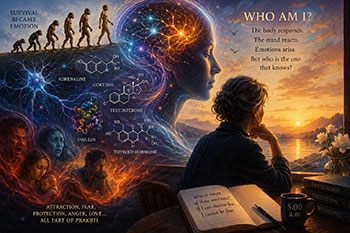
The word emotion has a fascinating history because its original meaning had nothing to do with feelings. It meant movement. Here's its linguistic journey: Latin: emovēre; e- (or ex-) = "out of" and movēre = "to move"
So emovēre literally meant "to move out," "to move away," "to set in motion," or "to disturb."
It then passed into:
Old French: émotion — meaning physical movement, disturbance, agitation, even public unrest or a riot.
English (16th century): emotion initially retained this sense of commotion or social disturbance.
There is no single "site" of emotions. Emotions arise from networks in the brain, and they are expressed throughout the body.
From an anatomical and physiological perspective, here are the principal players:
The amygdala — the alarm and salience detector
The hypothalamus — the commander of the body
The hippocampus — context and memory
The prefrontal cortex — the regulator
The anterior cingulate cortex
The insular cortex
The brain interprets signals returning from the body. You may notice:
Tight chest
"Butterflies" in the stomach
Lump in the throat
Dry mouth
Trembling
Goosebumps
These sensations are largely mediated by the autonomic nervous system and conveyed back to the brain, especially through the vagus nerve and spinal pathways.
As a physiologist, I instinctively began to reconstruct their evolutionary history. The first living organisms could not possibly have experienced fear in the way we understand it. A primitive cell had no brain, no nervous system, and certainly no amygdala. Yet it already possessed something that, in retrospect, appears to have been the precursor of emotion. It could distinguish between what favored its survival and what threatened it. It moved toward nutrients and away from toxins. Attraction and rejection existed long before consciousness could reflect upon them.
As evolution proceeded, these simple biological responses became progressively more elaborate. The appearance of nervous systems permitted rapid communication throughout the organism. Hormones and neurotransmitters refined the process even further. What had once been a simple movement toward or away from a chemical gradient eventually became fear of a predator, attraction toward a mate, protection of offspring, and defense of territory.
Much later, when brains acquired memory, anticipation, abstraction, and self-awareness, these ancient mechanisms acquired forms that are uniquely human. Fear became anxiety. Attraction became attachment. Protection could become possessiveness. Competition could degenerate into greed. Defense could become hatred. The biological mechanisms had not fundamentally changed; they had simply become capable of operating in a far more complex mind.
At that point another thought occurred to me. Suppose I could return to the very beginning and ask God a question.
"Why did You place these mechanisms within living beings? Why create hormones and emotional systems that have led not only to survival but also to jealousy, greed, hatred, wars, insomnia, and endless suffering? Would it not have been better to omit them altogether?"
The answer that came to my mind surprised me.
"My child, before these mechanisms produced hatred, they protected life. Before they produced greed, they enabled organisms to gather sufficient resources to survive. Before they produced anxiety, they prevented your ancestors from walking calmly into danger. Remove these mechanisms, and there would be no living being left to ask the question."
From the perspective of evolutionary biology, the answer is entirely satisfactory. Emotions did not evolve in order to make us happy. They evolved because they increased the probability that organisms would survive long enough to reproduce.
Yet, as I followed this line of reasoning, I became aware that evolution had answered only one of my questions.
It had explained why emotions exist. It had explained why hormones became indispensable to survival. It had even explained why organisms capable of fear, attachment, aggression, and protection left more descendants than those that lacked such mechanisms. But none of that answered the question that had awakened me before dawn.
If every emotion is accompanied by a cascade of hormones, if every hormonal change alters my thoughts, my perceptions, and even my capacity to sleep, then who, precisely, is aware of those changes? The body responds; the nervous system responds; hormones circulate through the bloodstream, bind to their receptors, and modify the physiology of every organ they reach.
Thoughts appear, emotions arise, fear comes. And then anger comes or attachment comes. Even joy comes. All of them are in constant motion, as though they belonged to an immense river that has never ceased flowing since life first appeared upon the Earth.
Yet something curious remains. If I can observe my fear, then I cannot be identical with fear. If I can notice my anger, then anger cannot be the totality of what I am. If I can recognize that hormones are influencing my thoughts at a particular moment, then there must exist, however elusive, a point of observation that is not itself a hormone.
Perhaps that is the question that biology cannot answer.
Biology can explain the mechanisms by which the organism survives. It can trace every emotional response to neural circuits, endocrine glands, neurotransmitters, and hormones. It can reconstruct the evolutionary history of each of these mechanisms with remarkable precision.
But the simple question, "Who is aware of all this?" belongs to another order of inquiry.
Perhaps the greatest confusion of human life consists in identifying ourselves completely with that endless biological movement.
The emotions are real. The hormones are real. The physiology is real.
Yet perhaps none of them, individually or collectively, is the final answer to the question, "Who am I?"