THE HERMIT WOLF
TRUTH LOGS
THE HERMIT WOLF
TRUTH LOGS
THE HERMIT WOLF
TRUTH LOGS
THE HERMIT WOLF
TRUTH LOGS
Recently, I have made several purchases and transactions on the Web. I am an orchid enthusiast, so now and then I order precious orchids through orchid nursery websites. I already created a post about what happened when I bought a Twinkle Pink Fantasy that was sent using a famous mail carrier. The orchid was never delivered because the driver stated I was unavailable. You already know what happened. Now the orchid is hanging between life and death, and I do not have much hope that it will survive.
But then, because apparently I do not learn from experience, many more things started to happen. Let me first explain that I am a 78-year-old woman with several “ailments,” so traveling in search of the stuff I need is sometimes a bit difficult.
I needed a special kind of clothing, and I was advised that a company in Japan had precisely what I needed. I ordered it on July 24. It is still in what I call Limbo today, August 11, 2026.
Then I had the peculiar idea of paying a credit-card balance using a check. The check was sent on July 30, 2026. As of today, the check has not cleared and the amount I owe is still showing as unpaid.
Then I decided, again not learning from experience, to send a book of mine to my grandchild in California. I mailed it in August 7, and USPS currently expects it to arrive on August 14.
So I started wondering: what is happening here? Have I jumped back in time to the 1800s, or perhaps to the early 1900s? I decided to check the mailing and transportation processes of those two centuries.
I found that, in 2021, USPS formally lengthened the service standard by one or two days for some long-distance First-Class Mail, explicitly shifting more transportation from air to its ground network. Then came further network restructuring. In 2025, the USPS Inspector General concluded that implementation problems had negatively affected service performance and that on-time First-Class and Priority Mail performance had actually declined since FY2022—even after standards had been relaxed.
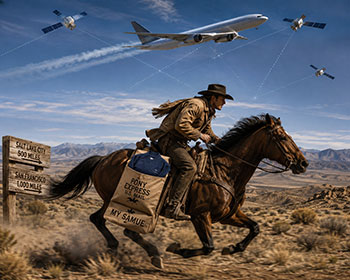
I said, okay, let’s see how it worked a hundred years ago, maybe even 200. As I saw it, my “samue” from Japan had left Tokyo in a balloon that searched for the best atmospheric currents toward America and had taken from July 30 to August 8 to land in California. After landing in the city of Bell Gardens, apparently it had been placed in a covered wagon, or perhaps handed to Kevin Costner’s partner in The Postman, who was heading toward the East Coast across deserts, ravines and dangers on his trusty horse, aiming for dangerous, crocodile-infested Florida.
I remembered that my grandson had driven from New York to San Francisco, California, in three days, so I wondered: Why is the postal service telling me that my package from Japan will arrive by August 15? Seven days from its Bell Gardens scan to its expected Miami delivery? Isn’t that too much?
A person leaving Tokyo and coming to Miami does not take two or three weeks. He or she can be in Miami within three days at most. Why this extreme delay?
So I decided to stop speculating and look at the historical numbers. This is what I found.
| Period | Route | Transport | Approx. travel time | Evidence / note |
| 1869 | East Coast ↔ San Francisco | Transcontinental railroad | ~7 days | After completion of the transcontinental railroad, passengers and freight could cross the country in about seven days. (Census.gov) |
| 1876 | New York → San Francisco | Transcontinental Express | 83 hours (~3½ days) | U.S. Census history specifically reports an 83-hour transcontinental trip only seven years after the railroad opened. (Census.gov) |
| 1912 | San Francisco → Chicago | San Francisco Overland Limited | ~3 days (order of magnitude) | The 1912 Southern Pacific timetable documents through Pullman service from San Francisco to Chicago; this was already a mature transcontinental passenger system. (Wx4) |
| 1918 | San Francisco ↔ Yokohama/Tokyo region | Trans-Pacific steamship | ~17 days | The Tenyo Maru itinerary gives San Francisco Feb. 15 → Yokohama March 4: about 17 days. |
| 1920s | San Francisco → Chicago | Fast transcontinental train | ~2½–3 days | By the later 1920s, premier Overland services were around the 60-hour range between San Francisco and Chicago; contemporary timetables document the through service. (Streamliner Memories) |
| ~1910–1920s, estimated San Francisco → Miami Rail, with connections roughly 4–5 days There was no single San Francisco–Miami through train; this is a reasonable reconstruction from transcontinental schedules plus onward rail connections. Treat it as an estimate, not a timetable quotation. | ||||
| ~1918–1920s, reconstructed Japan → California → Miami Steamship + railroad roughly 21–23 days ~17 days Pacific crossing + roughly 4–5 days across the U.S. This is a reconstruction, not one advertised through itinerary. | ||||
| 2026 — my samue Japan → Miami International post + USPS 22 days expected Ordered July 24; USPS expected delivery August 15. | ||||
And that last comparison is extraordinary, because a reasonable early-twentieth-century reconstruction gives us something on the order of: Japan → San Francisco by steamship: ~17 days San Francisco → Miami by railroad: ~4–5 days Total: ~21–22 days And my “samue”: Japan → Miami: 22 days, if it arrives August 15.
There is an important historical qualification: we are comparing passenger schedules with an economy international postal shipment, not equivalent services. A parcel or mailbag in 1918 would have had its own handling and scheduling delays. I cannot claim that the postal service in 1918 would definitely have delivered my samue in 22 days. But I can make the much more defensible—and frankly more striking—comparison:
A human being in the early twentieth century could plausibly have traveled from Japan to Florida by steamship and railroad in roughly the same elapsed time that my package is expected to take to make that journey in 2026.
And the nineteenth-century continental comparison is almost comical: New York to San Francisco in 83 hours in 1876. (Census.gov.) That is 150 years ago. My book traveling to San Francisco is currently scheduled to take seven days from Miami.
We live in an age of astonishing technological achievement. Cars can drive themselves, artificial intelligence can sit with us at two in the morning discussing philosophy, and information can cross the planet in fractions of a second. Yet a package can take roughly as long to travel from Japan to Florida as a person could have made the journey by steamship and railroad more than a century ago.
Perhaps the problem is no longer what our technology is capable of doing. Perhaps it is what the systems—and the people and institutions behind those systems—choose to do with that capability. Progress cannot be measured only by faster machines, smarter computers or more automation. It must also be measured by reliability, responsibility, competence and pride in doing a job well.
Modern work is increasingly fragmented. The person who scans a package in California does not deliver it in Florida. The person who receives a check may perform only one tiny operation in a long payment-processing chain. The programmer responsible for one component of an automated pharmacy system may never meet the patient who is told, incorrectly, that her valid prescription does not exist. Responsibility can become so widely distributed that no individual experiences the final failure as entirely his or her own.
That does not mean nobody cares. Many people still take enormous pride in their work. But perhaps we have built systems in which caring about the quality of one’s own work matters less because the individual has less ownership of the final result.
Otherwise, we may find ourselves living in the twenty-first century, surrounded by extraordinary technology, while waiting patiently for the Conestoga wagon to arrive.