THE HERMIT WOLF
TRUTH LOGS
THE HERMIT WOLF
TRUTH LOGS
THE HERMIT WOLF
TRUTH LOGS
THE HERMIT WOLF
TRUTH LOGS
For most of human history, survival itself was an achievement worth noticing.
That is especially obvious in childhood. Before modern sanitation, vaccination, antibiotics, obstetric care, and reliable nutrition, infant and child mortality was extraordinarily high. A family could have many children and bury several of them before adulthood. In that context, reaching another year was evidence that a child had survived another dangerous interval of life.
Ancient civilizations acknowledged the passage of another year in different ways. Herodotus wrote that among the ancient Persians, birthdays were occasions for unusually large meals. Wealthier families might serve an entire roasted animal, while poorer families would still prepare a meal larger and more elaborate than their everyday fare.
The Romans had the dies natalis, the anniversary of one's birth. It could be marked with prayers and offerings of incense, wine, and ritual cakes, as well as vows and expressions of gratitude to the gods and protective household spirits. Family and friends might gather and share a meal.
China offers another, particularly beautiful, approach because traditional Chinese culture placed great value on longevity, elders, and ancestors.
I remember an anecdote—I no longer remember where I first encountered it—about a Westerner being asked his age by a Chinese person. When he replied that he was forty-five, apparently thinking that was already a considerable age, the response was something like: “Do not worry. You may still reach an older age.”
I have always liked that.
Longevity brings experience. It gives a person the ability to remember events that have long passed and to tell younger generations about people and times they themselves never knew.
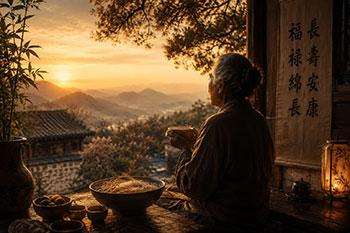
One traditional Chinese birthday food expresses this beautifully: long-life noodles, chángshòu miàn (长寿面). The length of the noodle symbolizes the continuation of life, which is why traditionally one does not want to cut the noodle short. The observance may include family gathering together, auspicious foods, and wishes that the person enjoy still more years of life.
The message is simple:
You have lived this long. May you live longer still.
Medieval Christian Europe presents a somewhat different case. The exact numerical anniversary of a person's birth was not necessarily the important annual personal celebration that it is today. Instead, many people observed a name day, or the feast day of the saint whose name they carried.
For years, for example, my mother and I celebrated our saint's day: Santa Hortensia.
During the eighteenth and nineteenth centuries, particularly in Europe , children's birthday celebrations became increasingly recognizable as something closer to the birthdays we know today.
But consider a French peasant mother centuries earlier. She may never have held what we would now recognize as a child's birthday party. There may have been no candles, no decorated cake, no pile of presents. That does not mean another year of her child's life was insignificant. When childhood illness could so easily take a son or daughter, survival itself mattered.
Some religious communities have regarded birthday celebrations with suspicion or rejected them altogether. Early Christians sometimes associated birthday observances with pagan customs. Jehovah's Witnesses today explicitly do not celebrate birthdays. Their interpretation draws on several biblical and historical arguments, including the negative circumstances surrounding the birthday celebrations mentioned in the Bible and their belief that excessive attention should not be directed toward an individual.
In simplified form, part of the concern is this:
Concentrating too much attention upon an individual risks undue self-exaltation, when worship and exaltation properly belong to God.
The ancient traditions can almost be reduced to four sentences:
Persia: You survived another year—come, we feast.
Rome: You survived another year—give thanks, make offerings, gather family and friends, and eat together.
China: You survived another year—eat the long noodle, and may your life become longer still.
Medieval Christian Europe: Your exact numerical birthday may matter less; your life is situated within family, Church, saint's day, and the recurring communal calendar.
And now we arrive in the twenty-first century.
For many people today, birthdays mean a large family gathering, eating together, receiving presents, and being treated as the special person of the day. Even offices and companies sometimes set aside a day each month to celebrate everyone whose birthday falls during that month.
For some people, perhaps it is simply a personal day—a day when they expect special treatment or feel entitled to take time away from ordinary responsibilities.
For others, a birthday marks a milestone they have been waiting to reach: the age at which they can obtain a driver's license, legally drink alcohol, begin working, retire, or cross some other socially defined threshold.
And for still others, it may simply provoke the thought:
I am getting old.
But there is another possibility. A birthday can be a celebration not of the ego, but of continued existence. In my family, that was certainly true with my grandmother.
My grandmother lived to be ninety-five. She never concealed her age. She never subtracted years from her life. On the contrary, she was proud of them and would tell people exactly how old she was. And every time another birthday came, our feeling was essentially:
Look. Grandma reached another year. We had her with us for another year.
That was what mattered. The celebration was not focused on presents or on making one person the center of the universe. It was focused on the continued presence of a family member we loved.
Perhaps many people throughout the world still share some version of that idea: I survived another year.
And I think that is something worth celebrating.
We no longer live under the same perilous conditions faced by people in the ancient world or the Middle Ages. Medicine, sanitation, nutrition, and technology have changed the odds enormously.
But life has not ceased to be fragile.
And now, God willing, as I approach my seventy-eighth year on this planet, I can look back and say:
Look. I have lived seventy-eight years.
I have survived many things. I have enjoyed many more. I have had children and grandchildren. I have worked. I have learned. I have created. I have loved. And yes, I have buried many people who were extremely close to my heart.
Yet I am still here.
And I give thanks for that mercy.
And so, I Do Celebrate My Birthday.