I have always considered that a home should be a refuge. A place where we can close the door on the outside world, rest, recover, think, read, write, and enjoy the simple pleasure of being left in peace. However, after years of suffering, I suddenly came to the conclusion that my home had become a source of constant stress. And I keep wondering…
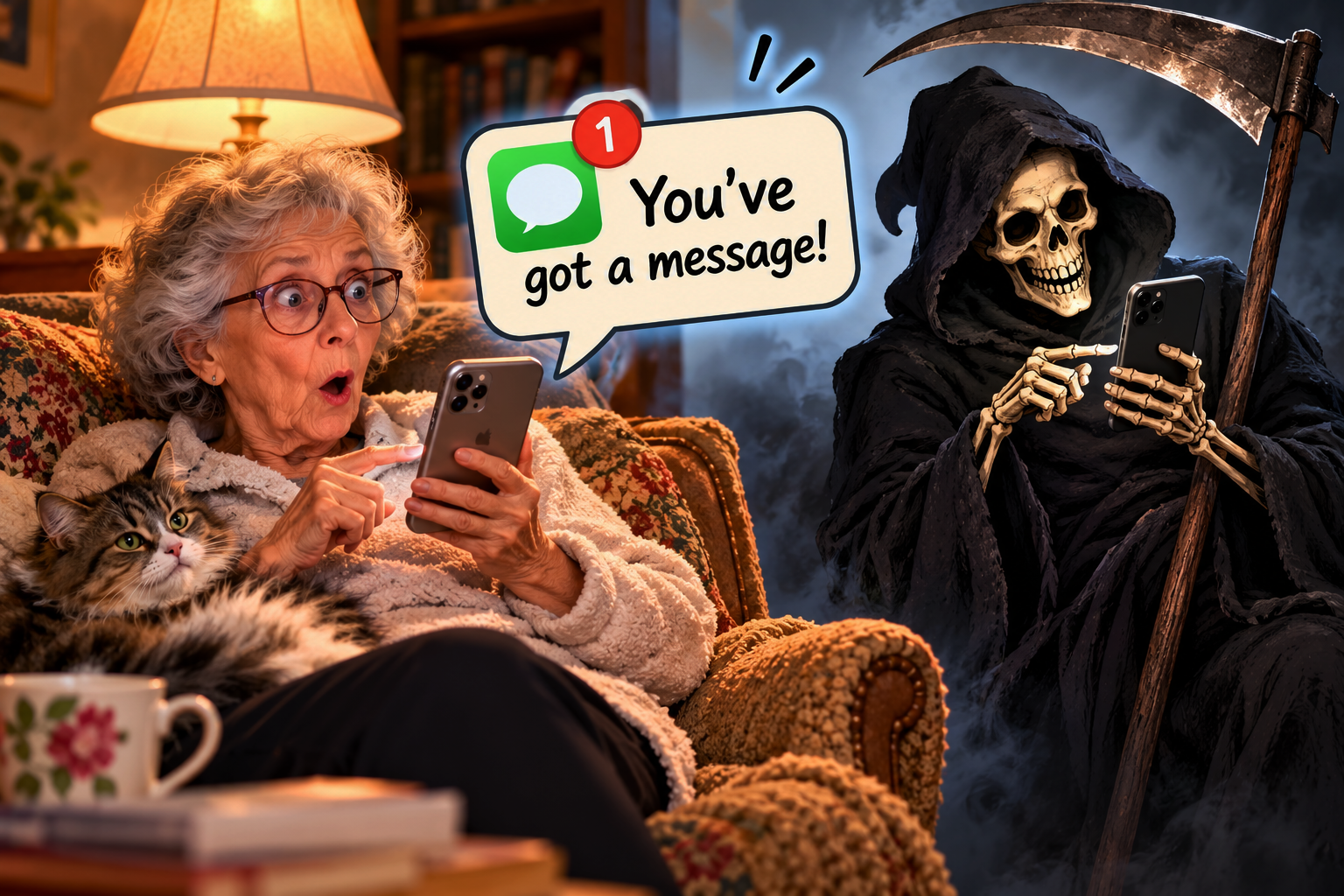
Nobody knows when the scythe-wielding specter of Death will come knocking. He certainly doesn't send you a text message on your iPhone announcing, “Expect me tomorrow at 6 p.m.!”
So the question that continues to haunt me is this:
Would the Grim Reaper have come knocking later if I hadn't spent so many years living under such stressful conditions?
Human beings are makers of extensions. We extend the eye with the microscope and the telescope, the hand with tools and machines, the voice with telecommunications, memory with writing and databases, calculation with computers, movement with aircraft and spacecraft, and now certain functions of cognition itself with artificial intelligence. This tendency to extend ourselves beyond the limits of the body is one of the defining characteristics of our species. We rarely accept the boundaries imposed by our senses, our environment, or even by nature itself. When we encounter a limit, some part of the human mind immediately asks whether that limit can be crossed.

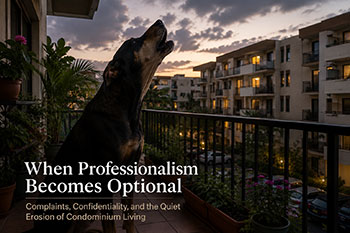
For more than a month, I have been living with a dog I do not own. Not literally, of course. The dog lives upstairs. But its barking, howling, movement, and the constant disturbance associated with it enter my apartment whether I consent to them or not.

Imagine a train that travels continuously through the Americas without stopping. A child is born on that train and has never known any other world. The floor, walls, furniture, people, and every familiar object share the train’s motion.
I did some research at the relationship between the condition of our homes and the way we feel. The results are consistent. People who experience their homes as cluttered, chaotic, unfinished, or difficult to manage tend to report more stress and a lower mood. Women who described their homes as cluttered or full of unfinished tasks also showed less favorable daily patterns of the stress hormone cortisol. Other studies found links between household chaos and symptoms of depression or anxiety.
Modern medicine speaks in numbers. Blood pressure, cholesterol, blood sugar, protein, and many other measures arrive on a lab report with a range beside them. If a value sits outside that range, a letter H or L appears. To the person reading the report, that mark can feel like a verdict: something is wrong.
The question that started this inquiry is simple. Who decided where “normal” ends and “abnormal” begins? The question is not an attack on doctors or on science. Clinics need cutoffs in order to act. Public health needs standards. Patients need some way to know when a result deserves attention. The trouble starts when those cutoffs are treated as if they were laws of nature rather than human decisions about risk.
The theory proposes that at some point during the Castro era, an undocumented geothermal–metaphysical rupture opened beneath Cuba, creating a persistent conduit between the island and the lower thermal regions of Hell. The rupture, known scientifically as La Compuerta Infernal Cubana, continuously releases anomalously hot air into the Caribbean boundary layer. Because Florida lies immediately downwind and north of Cuba, South Florida receives the highest measurable concentration of infernal thermal leakage.
I am very scared by what I have been observing lately. In two words, everything seems to be going to the dumps. I am not much out in the world anymore; in fact, my AKA is Hermit Wolf. I retired from work and, to a large extent, from the world in 2010, and I have not spent much time outside it since. The fact that even with so little contact I can still see services, professionalism, dedication, empathy, compassion, and a great many other human qualities deteriorating is, by itself, frightening.
There are forms of education that have almost nothing to do with schools, examinations, or degrees. They are learned much earlier, usually at home, through repetition, example, correction, and the quiet expectation that one must recognize the existence of other people.


In 2025, the USPS Inspector General concluded that implementation problems had negatively affected service performance and that on-time First-Class and Priority Mail performance had actually declined since FY2022—even after standards had been relaxed.
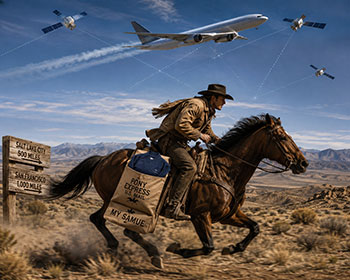
Every package has a story. One may contain a birthday present from a grandmother; another may contain irreplaceable legal documents, another may carry replacement parts that allow a small business to reopen after an unexpected breakdown.
The driver does not know if the package contains urgent medication, or treatment on which someone's life depends he or she has no way of knowing.
There are questions that begin in universities, born from years of formal research, statistical analyses, and scholarly debate. Others emerge much more quietly. They arise while hanging a painting on a wall, watching a child say goodbye to friends for the fifth time, or hearing that a hurricane has carried away not only a roof but an entire wall. Such moments seem unrelated, yet over time they begin to point toward the same question.
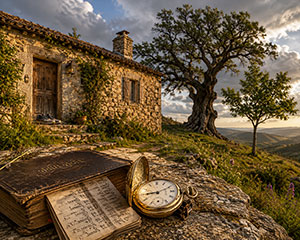
There was a time when silence was an ordinary part of daily life. Today, silence has become almost an inconvenience. We fill it with music, podcasts, television, telephone conversations, social media, and an endless procession of voices. Waiting for an elevator, driving to work, standing in line at the supermarket, exercising, or simply sitting in a room without speaking—every empty moment seems to demand occupation.

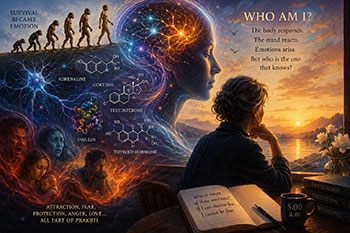
There is no single "site" of emotions. Emotions arise from networks in the brain, and they are expressed throughout the body.
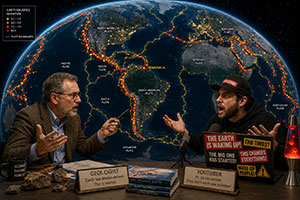
When a strong earthquake strikes somewhere in the world within minutes, before seismologists have finished locating the epicenter or estimating the final magnitude, the machinery begins to move. Notifications appear. Videos multiply. Faces wearing expressions of grave certainty look into cameras and announce that this is not merely another earthquake. No, this one is different. This one is a warning. The Earth, they tell us, is entering a new phase.
I was brough awake today with the phrase: “Yester
For most of my life, I have been fascinated by a question that has never left me: Why do some people seem to live in only one room of life's mansion, while others wander endlessly from room to room, discovering new wonders behind every door?

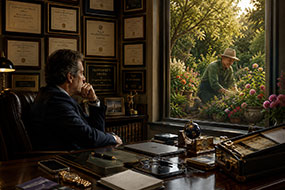





There was a time when suffering, however unbearable, was not meaningless. A person in pain did not immediately reach for something to silence it. They prayed. They performed rituals. They spoke to God—by whatever name their culture had given Him—and in that act, they faced their suffering instead of escaping it. Pain was not just endured; it was held within a framework, a structure that gave it weight, direction, and sometimes even dignity.
In every building there emerges, sooner or later, a new species—not listed in any formal taxonomy, yet unmistakable once observed. Ours has now stabilized into a recognizable form: Homo terraceños vocalis.

A hosting company is not just renting space. It is, implicitly, a custodian of continuity. That includes redundancy, backups, and the ability to restore a system when something breaks.

It has always shocked me how easily people believe that harm can be settled with words. “I’m sorry.” As if that were enough. As if saying it could reverse what has already happened.
There are, of course, true accidents—events no one could have prevented. But many of the things we call accidents are not accidents at all. They are failures of attention. Failures of awareness. Failures of responsibility: a person looks at a phone instead of the road; a person acts without considering consequences.
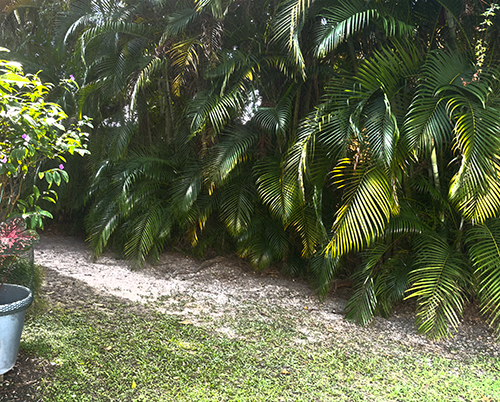
In my neighborhood there is a small war taking place. It is not fought with armies or weapons, and yet the destruction is constant. The victims are the plants, the trees, the living green world that tries to exist around us. Branches disappear overnight. Bushes are cut to stubs. Tree canopies are stripped until nothing remains but a skeleton against the sky.

In his short story The Billiard Ball, Isaac Asimov stages a confrontation between two former classmates whose lives have diverged dramatically. One becomes a Nobel Prize–winning physicist. The other becomes a powerful politician. The scientist represents intelligence, discipline, and the search for truth. The politician represents influence, ambition, and control over society. He reminds the physicist of a brutal reality. Knowledge may reveal how the universe works, but knowledge does not rule the world. Power does. The scientist opens the door; the world that enters afterward is rarely governed by the scientist.
There is something deeply troubling in the way humanity recognizes its greatest creators. Again and again, the same pattern repeats: people who give extraordinary things to the world are ignored during their lifetimes and praised only after they are gone. We applaud too late.
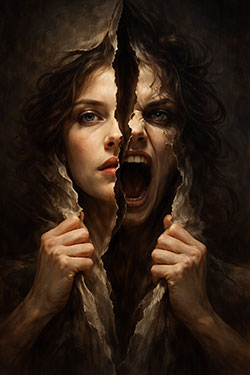
Schizophrenia was often interpreted very differently.
The condition itself may not have changed — but its meaning has.
In many traditional societies, individuals who heard voices or saw visions were not automatically considered ill. Instead, they were sometimes regarded as people standing at the threshold between worlds. Shamans, healers, and seers often described experiences that today would be classified as psychotic. Dreams, visions, and voices were treated as meaningful events requiring guidance rather than suppression.

We often imagine memory as a storage room. Something happens, and we “put it away.” But memory is not storage. It is reconstruction. Each time we remember something, we rebuild it. We connect what happened, how it felt, where we were, who we were at the time; and from those pieces, we create continuity. That continuity becomes identity.

From a strictly biological perspective, humans evolved in a world ruled by the Sun. Long before artificial light, before enclosed rooms and climate control, our metabolism was calibrated to a 24-hour light–dark cycle driven by solar radiation.
One of the measurable consequences of modern life has been the steady rise in vitamin D deficiency across populations. At the same time, elevated cholesterol levels are increasingly observed—even in younger individuals. The connection is not mystical. It is biochemical.
There are professions that attract people because of prestige, travel, or visibility. Others attract those with a quieter motivation — the impulse to protect, to repair, to guide, or to save. Yet some of these professions, while outwardly admirable, impose a particular cost on the individuals who choose them. That cost is not only physical. It is psychological and existential.

A date appears on the calendar: Friday the 13th.
Nothing has changed in the sky. The Earth continues its orbit. The Sun rises and sets without hesitation. The laws of physics do not bend toward superstition. And yet the square containing the number acquires weight. People hesitate. They postpone travel. They joke — and beneath the joke there is unease.

There is a parable in the Gospel of Matthew about workers hired at different hours of the day, all paid the same wage. When the first laborers protest, the owner replies that he has done them no wrong — they received what was promised. Those who labored longest feel displaced when latecomers receive equal reward. The landowner’s defense rests not on proportional fairness but on generosity.The story is meant to illustrate divine grace. It is not an economic theory..
A democracy, however, is not a vineyard owned by a single will. It operates through law, contribution, taxation, and consent. Grace and governance are not the same thing..

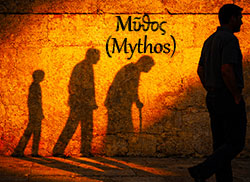
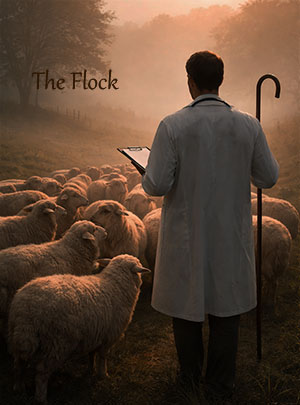


Although this text draws on biological facts, it is not intended as an entomological study. Nature is approached here not as an object of classification, but as a source of insight. The observations that follow use the life cycle of a living being as a lens through which to consider transformation, continuity, and meaning—questions that belong as much to philosophy as to science.




You arrive on time—sometimes early. You sit. You wait. An hour passes. Two. Sometimes three. The appointment time printed on the paper becomes meaningless, ceremonial.